
The moment a clinician decides whether to trust the AI.
This guide covers six interface decisions that shape whether trust in healthcare AI is won (clinicians act on AI output) or lost (clinicians quietly work around it).
An AI model can perform exceptionally well in validation and still go unused in a hospital. The real test comes when a clinician has a patient in front of them: will they trust the AI’s output enough to act on it when every second counts?
Accuracy is only part of that decision. Clinicians also need to understand where a recommendation comes from, how reliable it is, and what to do when it conflicts with their own judgment. They are the ones responsible for the clinical decision, so an AI system that produces an answer without enough context is hard to rely on. That’s why trust has to be designed into the product from the start, and why it’s worth checking for before a tool reaches the ward. We explore how design governance shapes that in designing for clinical trust.
An accurate model no one acts on is just an expensive second opinion nobody asked for.
An AI tool that clinicians ignore still has a cost. The hospital pays for it in duplicated work, in alerts dismissed on reflex, and in lost confidence: once clinicians learn that one AI tool doesn’t help, they approach the next rollout with the same skepticism. This is part of a broader healthcare UX problem: technically sound products can still fail when they add friction to already complex clinical workflows, a pattern we also cover in our digital healthcare UX trends for 2026.
Lastly, a good interface can’t compensate for an AI system that hasn’t been properly validated or cleared for clinical use. But once those requirements are met, UX must help clinicians understand and act on the output. We look at why so many tools stall at that stage in why healthcare AI fails after the prototype.
So what makes clinicians act on AI output rather than work around it? In our experience designing clinical products, it comes down to six interface decisions. They aren’t sequential steps; each addresses a different reason a clinician might hesitate. Whether you’re building a clinical AI tool or evaluating one for your hospital, you can use them as a review checklist.
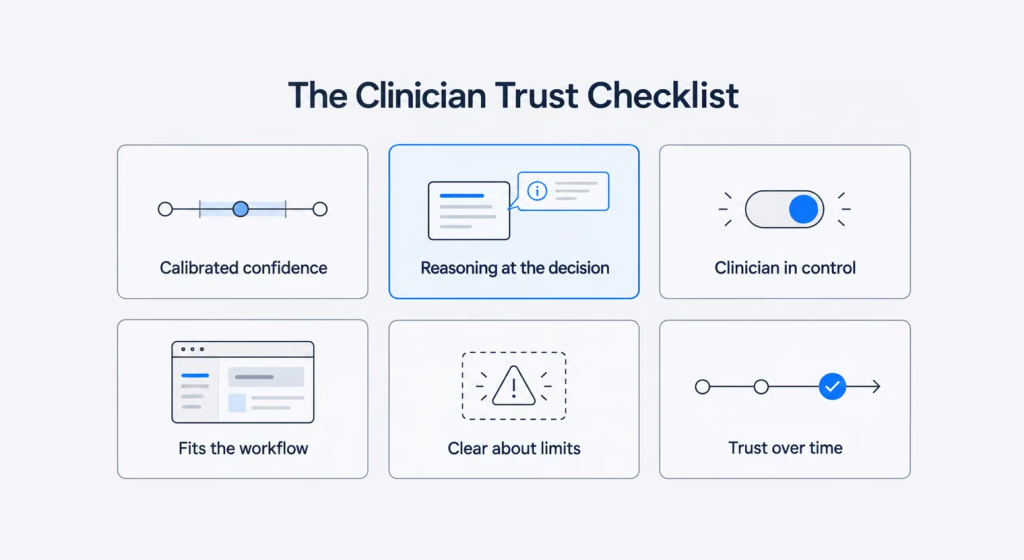
The clinician trust checklist at a glance
Show calibrated confidence
A confidence score, a number that shows how certain an AI is about a prediction or an output, is useful if clinicians can understand what it means and how it should affect their decision. 92% looks precise, but it raises obvious questions: 92% of what? Based on which patients? And would the recommended action change at 88%?
The interface should calibrate that confidence. For a quick triage decision, a simple high-risk flag may work better than a precise-looking decimal. When it comes to a borderline case, a range can communicate uncertainty with precision no single number ever could. Adding relevant context about the basis for the prediction can also make the output easier to assess.
Actionable advice: check how the interface behaves when the model is unsure. When low-confidence results look as certain as high-confidence ones, clinicians get no clear signal to double-check them.
Keep the clinician in control of the call
Human-in-the-loop is a common phrase and is often implemented poorly in AI interface design. In practice, it means the clinician remains the decision-maker, and that disagreeing with the AI is no harder than accepting it.
In a study published in Radiology, radiologists who reviewed mammograms alongside deliberately wrong AI suggestions often followed them. Accuracy among very experienced radiologists fell from 82% to 46%. The conclusion is quite simple: interfaces don’t just present AI judgments; they shape how hard clinicians push back on them.
Two design choices can undermine the “human-in-the-loop” approach:
Actionable advice: count the steps needed to override the AI and compare them with the steps required to accept it. If overriding is much harder, check whether there’s a good reason for the extra steps.
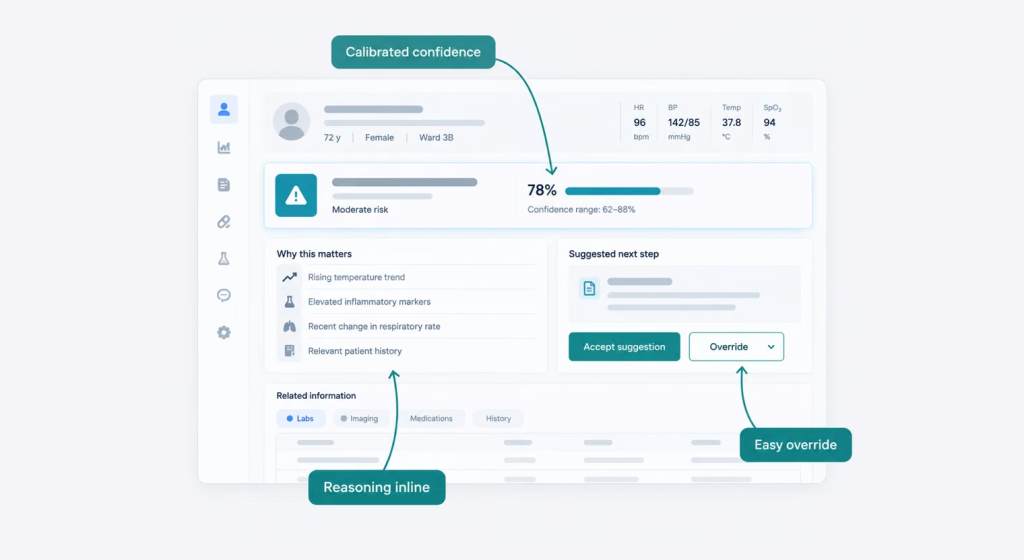
The clinician trust checklist at a glance
Make the AI fit the whole workflow
If acting on the AI requires a clinician to step out of what they are already doing, they are likely to stop using it, regardless of how good the model is. The AI needs to appear inside the tool the clinician is already using, at the point of decision. Depending on the situation, that might be the record, a device display, a mobile alert during rounds, or the handoff summary at shift change. It also needs to work within existing alert systems rather than add to the alert fatigue already common in critical care. The broader point is that workflow fit goes beyond EHR integration and includes the clinician’s whole working environment. Our guide to EHR implementation challenges covers where that integration usually breaks down.
Actionable advice: check where the AI output appears in the workflow and whether accessing it forces clinicians to leave the task they are already completing.
Be explicit about what the model cannot do
Being clear about a model’s limitations tends to increase trust, even though that can seem counterintuitive. A system that shows its edge cases and the situations where it has little data comes across as more reliable than one that appears equally confident in every case. The state where the model is unsure deserves as much design attention as the confident one. When the model is working outside what it handles well, it should say so and return the decision to the clinician.
Actionable advice: ask to see what happens when the AI is uncertain or outside its scope and check what the clinician sees and what they can do in each situation.
Uncertainty should be visible enough for clinicians to decide how much weight to give the output.
Let trust build over time
A good first impression is only a foundation for trust. Genuine long-lasting trust develops through repeated use, as clinicians see how the system behaves over time. A few things matter here:
This matters especially when a clinician overrides the AI. The system should make it clear that the action was captured rather than simply letting it disappear into the workflow. Clinicians may not expect every correction to change the model, but they should understand what happens to that feedback and whether it is reviewed, stored, or used elsewhere in the product process.
Actionable advice: Override a recommendation and see what happens next. The clinician should be able to tell whether the correction was recorded and what, if anything, happens to it afterward.
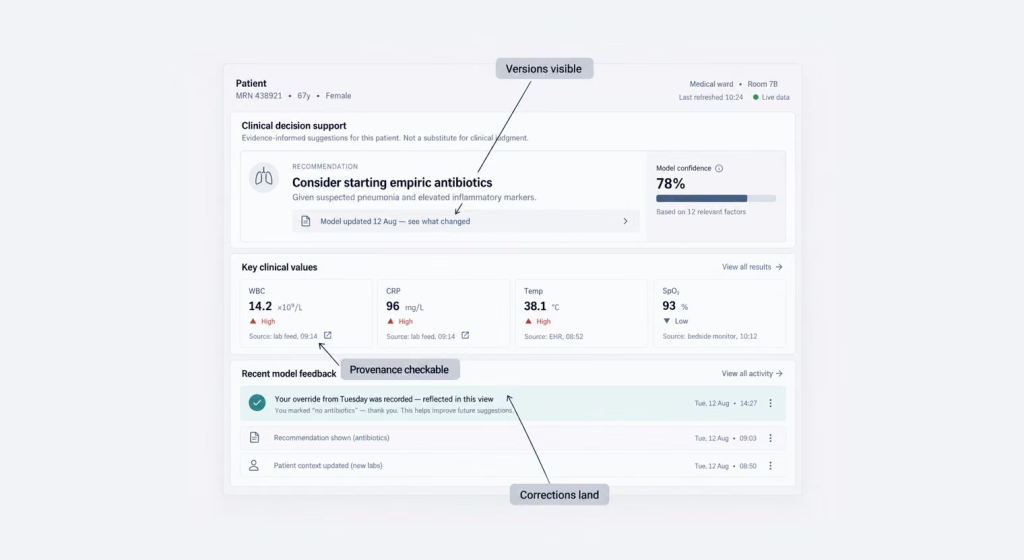
Provenance, versioning and feedback in one clinician view
More transparency doesn’t always mean more trust. In clinical AI, explanation layers tend to pile up: data science adds a confidence score, compliance adds a disclaimer, legal adds a caveat. Each addition may be reasonable on its own, but together they can bury the information a clinician needs to make the next decision. The same principle drives reducing cognitive load in ICU interfaces, where every extra element competes for attention.
The right amount of detail depends on the clinical situation. A time-critical alert needs a clear, focused hierarchy, while a case review or tumor board view can give clinicians more space to explore the evidence, uncertainty, and limitations. The default view should reflect that difference, surfacing what matters for the decision at hand while keeping deeper evidence within reach when the clinician needs it.
Trust is built through consistent interactions, thoughtful design, and clear communication of what an AI system can and cannot do.

Trusted by businesses across industries worldwide.
Fill out the form and our team will get back to you shortly.